Online Betting vs Fantasy Sports – What’s the Difference?

The expansion of the digital sports platform has presented numerous methods by which users can interact with the sport of cricket and any other game via the internet. Online betting and fantasy sports are two of the most talked about mediums. Although these two might seem the same on the surface, they are organized and operate in a very different way, being different in terms of predicting, sports knowledge, and being either legal or illegal and different in terms of risk and user experience.These differences should be understood before engaging in a given format.
1. Core Concept: Prediction vs Team Management
The primary difference lies in how participation works.
Online betting involves placing money on a specific outcome. For example:
- Which team will win?
- How many runs will be scored?
- Who will take the most wickets?
You choose an outcome, accept fixed odds, and win or lose based on the result.
Fantasy sports, on the other hand, require users to build a virtual team made up of real players participating in an actual match. Points are awarded based on the real-life performance of those players—runs scored, wickets taken, catches, and so on.
In short:
- Betting = predicting match outcomes.
- Fantasy sports = managing a virtual team based on player performance.
2. How Skill and Strategy Differ
Fantasy sports are typically viewed as a skill based sport since one needs to succeed on the basis of:
- Player statistics
- Pitch conditions
- Matchups
- Recent form
- Team combinations
Before choosing a lineup, participants will have to assess data.
There is also research and analysis involved in online betting; Mahadev Book Whatsapp number however, the format is result-driven. It is not possible to control the bet after placing it. All this is determined by the occurrence of the event that was predicted.
To elaborate, in the case of tournaments that are hosted by the Board of Control of Cricket in India, fantasy players can do research on the strike rate in a certain location, whereas bettors are more interested in the probability of a team and market odds.
3. Legal and Regulatory Differences in India
The legal classification is very different in India.
Fantasy sports platforms usually present themselves as a competition based on skill. Under some formats, fantasy sports have been accepted by several court decisions in India as games of skill.
Online betting is however subject to the laws of gambling which are different in various states. Depending on the state, some types of online wagering are legal, some limited and some illegal.
They must always analyze the relevant laws in their area of operation before engaging in both activities.
4. Risk Structure and Financial Exposure
Online betting typically offers immediate financial resolution. You place a stake, and the match result determines profit or loss.
Fantasy sports contests usually involve entry fees pooled into prize structures. Returns depend on your ranking within the contest rather than a single match outcome.
Risk characteristics differ:
Online Betting
- Higher volatility
- Immediate win/loss outcome
- Odds determine payout
Fantasy Sports
- Competitive leaderboard format
- Requires outperforming other participants
- Multiple payout tiers possible
Both involve financial risk, but the structure of that risk varies.
5. Odds vs Points System
The distinction in the calculation of returns is one of the most obvious ones.
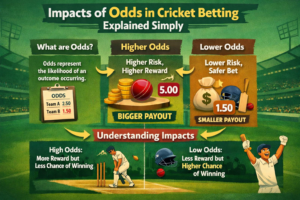
Online betting uses odds. For example:
When the odds is 2.00 and you bet [?]1,000, then you get [?]2,000 to the extent you are right.
There are no odds in fantasy sports. Instead they are based on a points system of scoring
Fantasy sports do not use odds. Instead, they rely on a points-based scoring system:
- 1 run = specific points
- 1 wicket = specific points
- Bonuses for milestones
Your payout depends on contest ranking rather than fixed probability pricing.
Some users searching for betting platforms encounter terms like mahadev book id, which are associated with online betting access systems. These operate entirely differently from fantasy sports apps that revolve around lineup creation and leaderboard scoring.
6. Control During the Match
In betting:
- Once the bet is placed, there is no control unless live betting or cash-out options are available.
- The outcome depends solely on the selected event.
In fantasy sports:
- You control player selection before the match begins.
- Some formats allow substitutions before deadlines.
- Strategic captain and vice-captain selections multiply points.
Fantasy participation feels more interactive because users actively construct their strategy.
7. Psychological Experience
In betting:
As soon as the bet is made, it is done and cannot be controlled except in the case of live betting or cash-outs.
The result is only limited to the event chosen.
In fantasy sports
You have control in the selection of players prior to the commencement of the match.
There are certain formats in which substitutions can be made prior to deadlines.
The points are multiplied by choosing strategic captains and vice-captains.
The involvement in fantasy is more interactive since the players create their strategy.
8. Data Usage and Research Approach
Fantasy players typically analyze:
- Individual player strike rates
- Bowling economy
- Venue history
- Batting position
Betting participants analyze:
- Team form
- Head-to-head statistics
- Toss impact
- Market odds movement
For example, matches played at venues like Wankhede Stadium often produce high-scoring games. Fantasy users may select aggressive batters, while bettors might evaluate total runs markets.
Both rely on data, but the application differs.
9. Payout Structure Comparison
| Feature | Online Betting | Fantasy Sports |
| Payout Basis | Fixed odds | Contest ranking |
| Risk Type | Outcome-based | Performance-based |
| Skill Impact | Moderate to high | High |
| Interaction Level | Limited after bet | Active lineup management |
| Legal Status | State-dependent | Often classified as skill-based |
This table highlights structural differences rather than suggesting superiority of one over the other.
10. Responsible Participation
Regardless of format, financial responsibility is essential.
Best practices include:
- Setting a fixed budget
- Avoiding recovery betting
- Not using borrowed money
- Treating participation as entertainment, not income
Understanding the distinction between fantasy sports and betting helps set realistic expectations.
Frequently Asked Questions
1. Is fantasy sports safer than online betting?
Fantasy sports tend to be organized in competitions of skill-based, which can provide an alternative legal status in certain states of India. The two are, however, financially risky. The safety of platforms is determined more by responsible budget and platform legitimacy than format.
2. What is the difference between fantasy apps and a mahadev book id?
The games played on fantasy apps involve the user forming imaginary teams and playing against each other in a point-based game. A mahadev book id normally is linked with access to online betting markets in which users make a bet on the results of the matches through odds-related systems. There is a big difference in the operational structure and risk models.
Final Thoughts
Online betting and fantasy sports may revolve around the same cricket matches, but their mechanics, risk profiles, and user engagement models are fundamentally different.
Fantasy sports emphasize lineup strategy and player analysis. Online betting focuses on probability pricing and event outcomes. Legal frameworks, payout systems, and psychological experiences also vary.
Before choosing either format, understand how it works, evaluate your risk tolerance, and approach participation with discipline. Clarity about these differences leads to better decisions and more responsible engagement in digital sports platforms.